Policymakers in agriculture and forestry increasingly recognise the transformative potential of digitalisation. From boosting competitiveness and productivity to improving food safety, reducing waste, and strengthening supply security across food, wood, and the broader bioeconomy, digital solutions can address multiple policy goals simultaneously. They also offer pathways to reduce fertiliser, herbicide, and pesticide use, mitigate environmental impacts, and enhance biodiversity.
Beyond these benefits, digital technologies can significantly reduce administrative burdens by automating reporting tasks. At the same time, they enable regulators to gain a more accurate, real-time understanding of land use and farming practices, improving preparedness for emerging risks such as plant diseases, pest outbreaks, and wildfires. This evidence base strengthens the design and implementation of effective policies.
Recognising these opportunities, the EU has placed digitalisation at the core of its strategic agenda. Initiatives such as the EU digital strategy for agriculture and the development of sectoral data spaces (e.g. the AgriDataSpace under the European Strategy for Data) aim to unlock the full potential of data-driven innovation in the sector.
However, realising these benefits depends on widespread adoption. Digital tools, infrastructures, and services must be deployed at scale and taken up by farmers and forestry operators. For policymakers, this raises a critical question: how will digitalisation evolve, and where should policy support to or intervene?
The 4Growth project addresses these challenges by combining ground-truth data (collected through stakeholder surveys) with forward-looking market estimates of digital technology uptake up to 2040. These estimates cover:
This provides a robust baseline for evidence-based policymaking.
Policymaking today does not happen under stable conditions. Geopolitical tensions, technological disruptions, and shifting societal priorities challenge even the most robust assumptions.
Can baseline projections alone support future-proof decisions?
To address this, the 4Growth team developed three foresight scenarios that allow policymakers to stress-test their strategies through “what if” questions:
These scenarios provide alternative, plausible futures against which policy assumptions can be tested.
The 4Growth Visualisation Platform integrates these scenarios directly into its analytical tools, allowing users to explore how different futures shape the uptake of digital solutions.
But what does this mean in practice?
Let’s consider a typical policymaking task:
Task: Increase the uptake of digital technologies through targeted funding
To design effective funding strategies and avoid windfall effects, policymakers need to understand:
The platform provides exactly this overview:
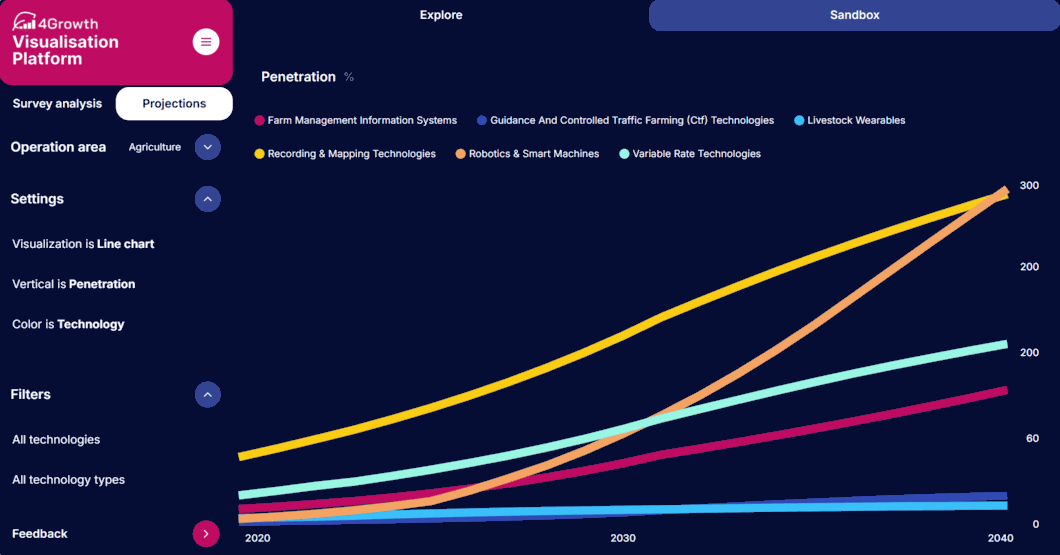
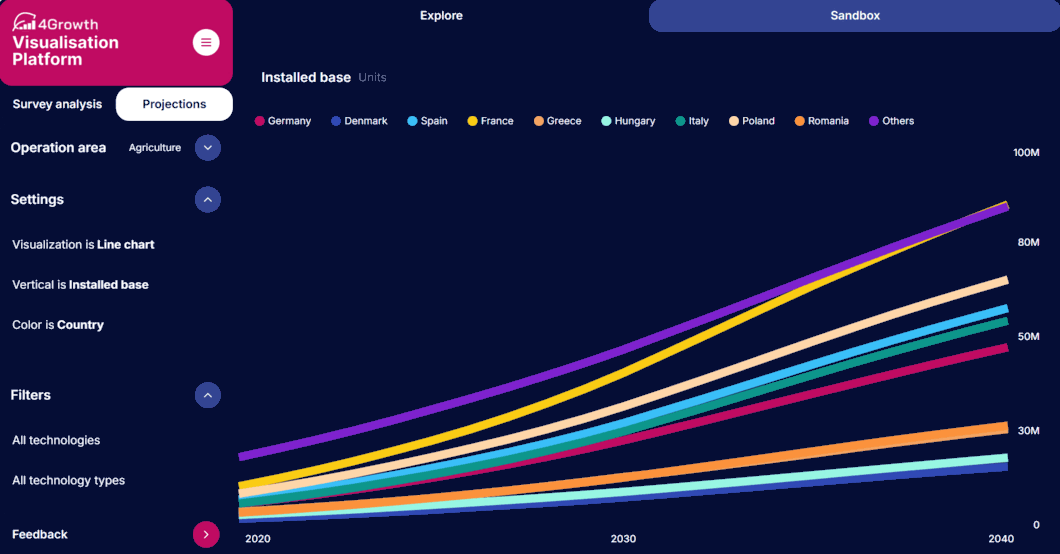
In addition, policymakers can explore country-level differences. For example, the installed base of digital technologies is currently highest in countries such as France, Poland, and Hungary, all showing strong growth dynamics.
The real added value emerges when these insights are tested against different futures:
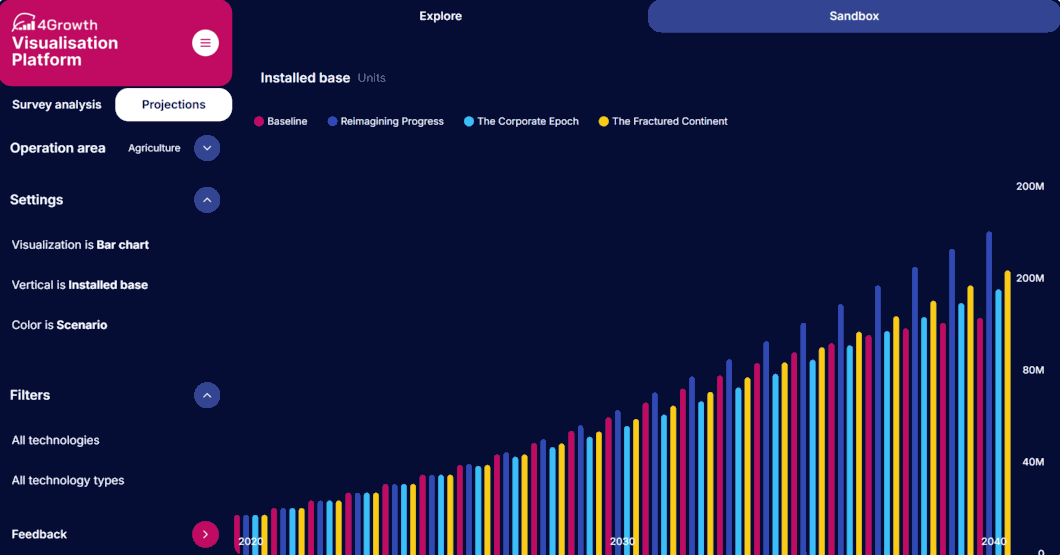
A platform for informed, future-proof policymaking
This example only scratches the surface of what the 4Growth Visualisation Platform offers.
Users can:
By combining data, modelling, and foresight, the platform enables policymakers to better understand uncertainty, and to design more resilient, forward-looking policies.
Explore the platform here: https://visualisation.4growth-project.eu
The platform is currently in beta, and some data are still being refined. Nevertheless, it already provides rich insights and valuable functionality. We welcome your feedback via the platform’s feedback form.
Sign up to stay informed of news, key outputs and upcoming events!