Within the 4Growth project, the second wave of surveys deepens our understanding of how digital and data-driven technologies are embedded in agricultural practice across Europe.
In Spain, 123 respondents participated in Wave 2, 107 producers and 16 advisors. While sample sizes differ between the two groups, the findings provide a structured snapshot of digital uptake on the ground. These insights are provided by the Spanish 4Growth Observatory, led by INTIA.
Digitalisation is advancing in Spain, but not uniformly across actor groups. Advisory organisations appear to operate with a relatively consolidated digital set-up with a strong focus on managing and sharing information. Producers, by contrast, display a more heterogeneous adoption pattern, combining established tools with customised or locally adapted solutions. Several solutions are used in practice, but they are less uniform and often described as “other”, suggesting high diversity and/or difficulties fitting real-world practices into predefined categories.
The advisory digital toolkit prioritises information exchange, monitoring, traceability and coordination. Most (14 out of 16) report sharing data or information through apps and platforms ( 87,5%), and a large share (62,5%) also use farm management software and tools for recording and mapping data (for example, sensors and task recording on machinery). More advanced automation technologies, such as variable-rate technologies (37.5%), controlled traffic farming (25%) and robotic/autonomous systems (6.3%), appear less frequently in this group.
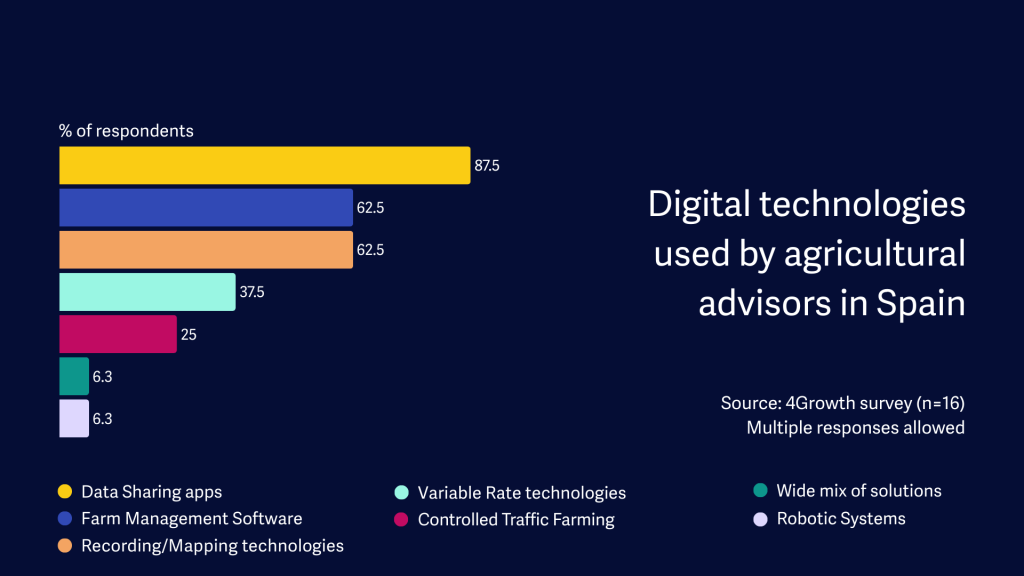
Given the small sample size (N=16), these results should be interpreted with caution. Nevertheless, they indicate a clear pattern of structured digital integration within advisory services.
The survey data reveals a more diverse landscape among producers.
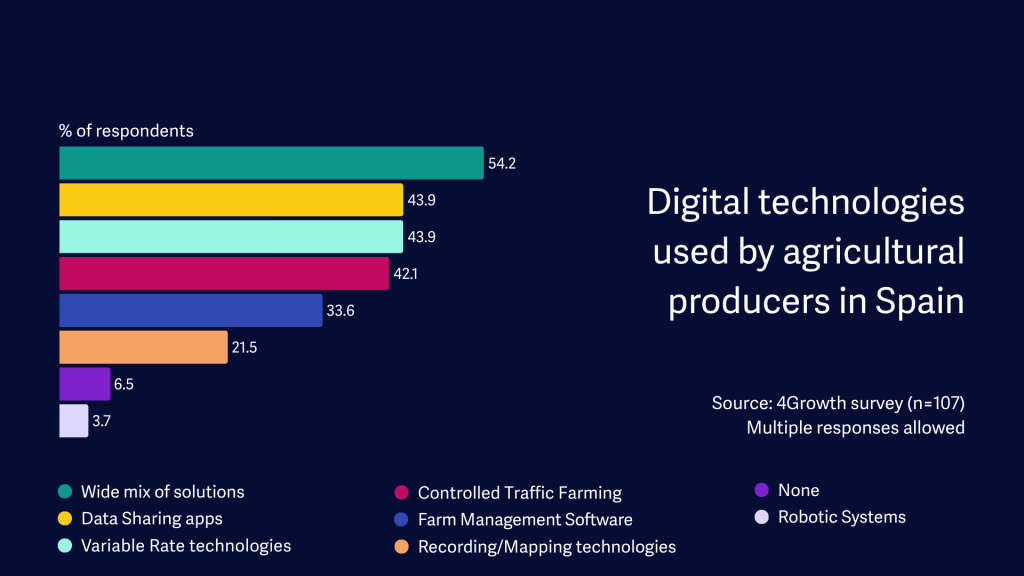
The prominence of the “wide mix of solutions” category for 58 respondents out of 107 (54%) suggests high diversity and localisation of digital adoption. Rather than adopting a uniform digital package, many producers combine tools adapted to specific crops, machinery configurations or local service ecosystems.
Further to data sharing apps, Precision farming technologies — particularly variable-rate technologies (43.9%,) and controlled traffic farming (42.1%) show significant uptake, indicating that field-level optimisation tools are gaining traction.
However, advanced automation such as robotics remains marginal (3.7%).
Looking at producers, 57.0% reported that digital technologies are integrated into the production process at their farm or organization (61 out of 107), By contrast, 32.7% said ‘no’. A further 4.7% did not know, and 5.6% gave no answer. Among advisors, integration appears much more widespread: 81.3% answered “yes” (13 out of 16), while 6.3% said they did not know and 12.5% gave no answer; notably, none of the advisors selected “no.” Overall, this suggests that digital technologies are reported as being more consistently integrated among advisors, whereas producers show a more mixed picture and a substantially higher share indicating that such technologies are not yet integrated into their production processes.
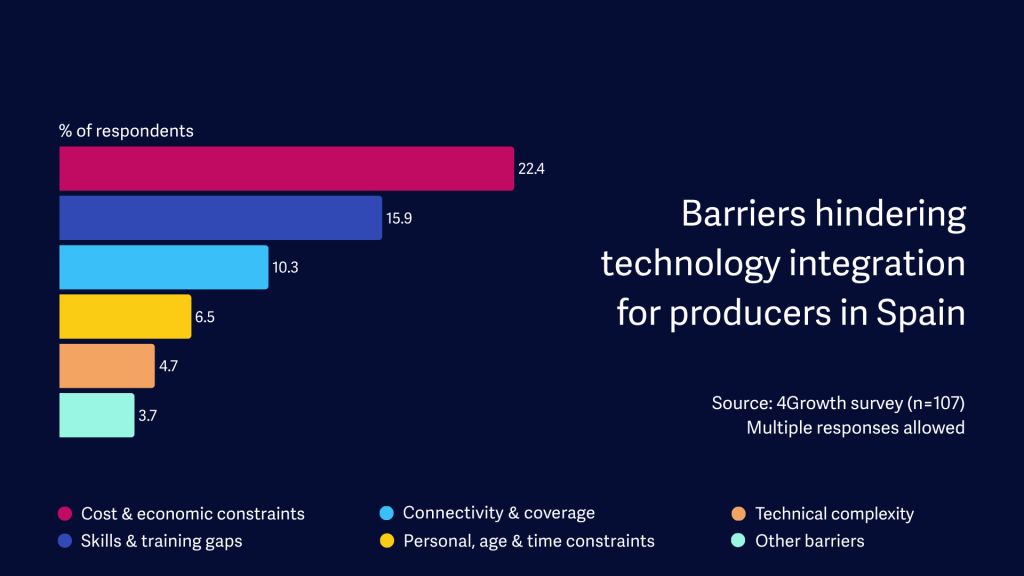
Among producers, the most frequently identified barrier was economic constraints, mentioned in 22.4% (24 out of 107) of the responses, indicating that cost and price remain the main limitation to further digitalisation. This was followed by training or knowledge gaps, with 15.9%, and connectivity or compatibility issues, with 10.3% . Less frequently mentioned were personal factors, with 6.5% , mainly related to age or lack of time, technological complexity, with 4.7% and other specific barriers, accounting for 3.7%, while 54.2% of the respondents (58 out of 107) provided no specific response to barriers identified. Multiple responses were allowed to this question.
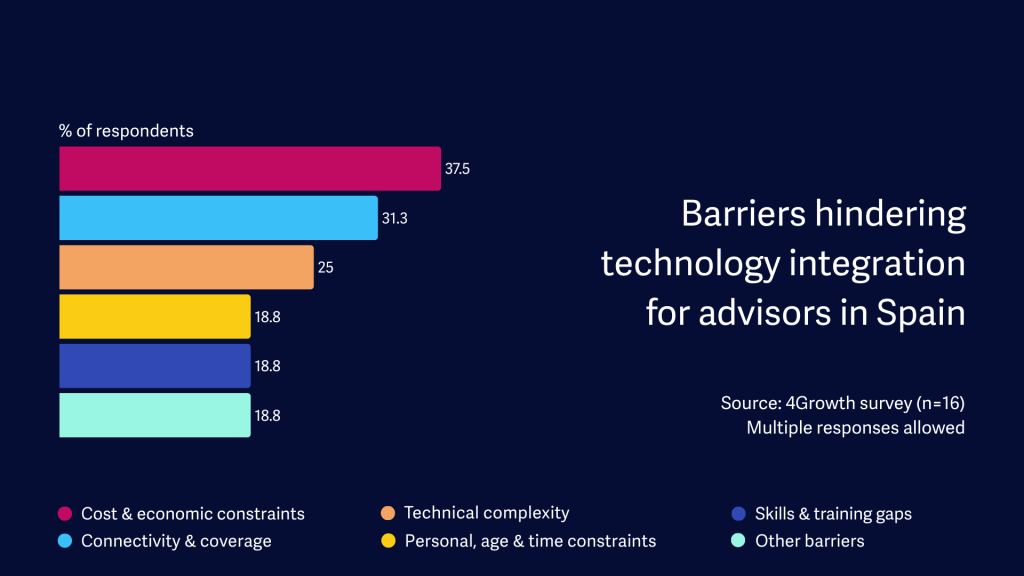
For advisors (multiple responses allowed as per above), responses were more evenly distributed across categories. Economic barriers were again the most cited, representing 37.5% (6 out of 16) of the responses. Connectivity issues represented 25%, while technological complexity accounted for 18.75%. Personal factors, training and knowledge limitations and other specific barriers each represented 11.11% of the responses. No specific response was given also by the 18.75% of advisors (3 out of 16).
Overall, advisors pointed to a broader variety of obstacles with a more balanced distribution, whereas producers placed greater emphasis on economic and knowledge gaps.
These findings reinforce a core 4Growth insight: accelerating digital uptake requires more than connectivity or equipment investment. It demands capacity-building, affordable and interoperable solutions, advisory support tailored to farm realities and skills development.
All data for this second wave were collected in the Spanish region of Navarra, providing a focused regional perspective on digital adoption patterns. At the national level, Spain coordinates such efforts through the Observatory for the Digitalisation of the Agri-food Sector, coordinated by the Ministry of Agriculture, Fisheries and Food.
The Observatory plays a strategic role in monitoring the uptake of digital technologies across the agri-food value chain. By tracking adoption trends across subsectors and regions, it supports the identification of good practices and informs evidence-based policymaking, contributing to the development of a more robust and innovation-driven digital ecosystem.
The third survey wave is currently underway. It will confirm whether the patterns observed in data collection waves 1 and 2 persist and whether convergence between advisory services and producers begins to emerge.
As the 4Growth evidence base expands, these findings will continue informing policy discussions on how to support inclusive and economically viable digital transformation across Europe’s agricultural systems and data will continue feeding into the 4Growth Visualisation Platform, to provide deeper insights into how digitalisation evolves across different forestry contexts in Europe, supporting evidence-based policies and innovation strategies for the sector.
Sign up to stay informed of news, key outputs and upcoming events!