For most survey respondents, digitalisation in European agriculture is paying off, though not to the same degree everywhere. The 4Growth Visualisation Platform provides insights into the uptake and impact of digital technologies across European agriculture and forestry. This post highlights three findings on agriculture, drawing on survey responses from selected European countries. They cover reported economic benefits, the role of connectivity in further adoption and the technologies most often in use.
In Poland, Hungary and Lithuania, 74% of respondents reported no barriers to further digitalisation, compared with just 32% in France, Spain and Belgium.
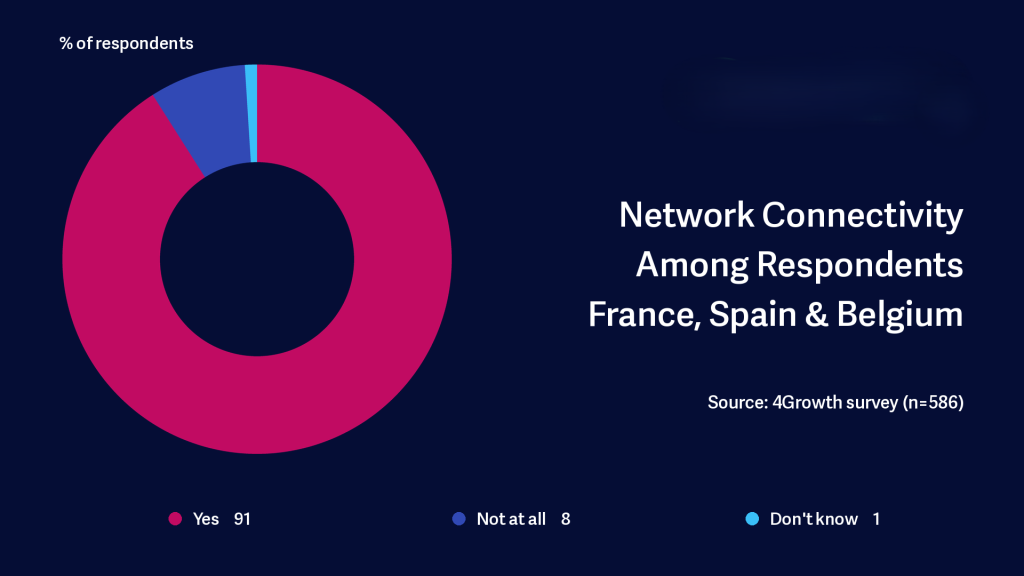
Interestingly, 91% of respondents in France, Spain and Belgium reported having network connectivity. This raises an important question: if connectivity is already widely available, what other factors are limiting further digitalisation?
To explore this, we compare the perceived economic benefits of digital technologies across the two groups. We then look at whether better connectivity would encourage further adoption, and at which technologies respondents in France, Spain and Belgium use.
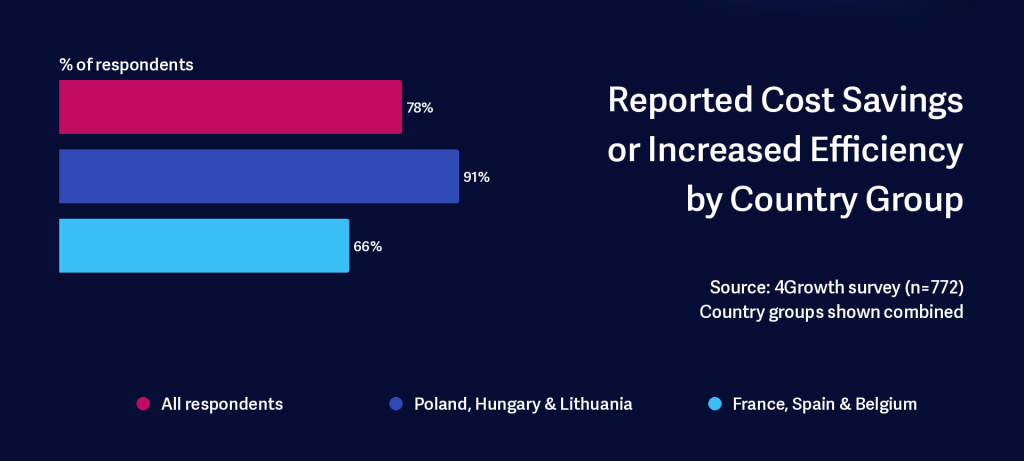
The headline findings are positive. Across all 772 respondents who answered the relevant survey question, 78% reported that digital technologies have resulted in cost savings or increased efficiency. For most of those using them, digital technologies are already delivering an economic benefit.
Behind this overall figure, however, the picture differs between the two groups. Positive responses reached 91% in Poland, Hungary and Lithuania combined, compared with 66% in France, Spain and Belgium combined, a gap of 25 percentage points.
This difference raises questions about why the perceived economic benefits of digitalisation vary across countries. Exploring the results country by country on the platform is a good place to start.
If digital technologies are delivering benefits, a natural next question is what would encourage respondents to adopt more of them. The survey explored this, including the role of better connectivity.
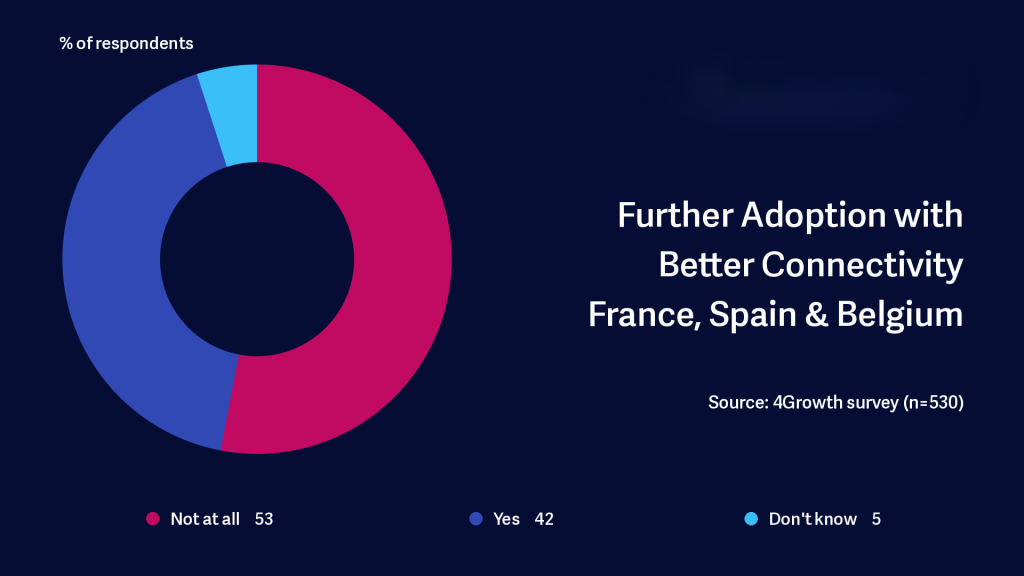
As noted above, connectivity is already widespread in France, Spain and Belgium. Yet more than half (53%) said better connectivity would not lead them to adopt more digital technologies. Two in five (42%) said it would.
This suggests that improving connectivity alone may not be enough to encourage further digitalisation. Other factors that influence adoption also deserve attention.
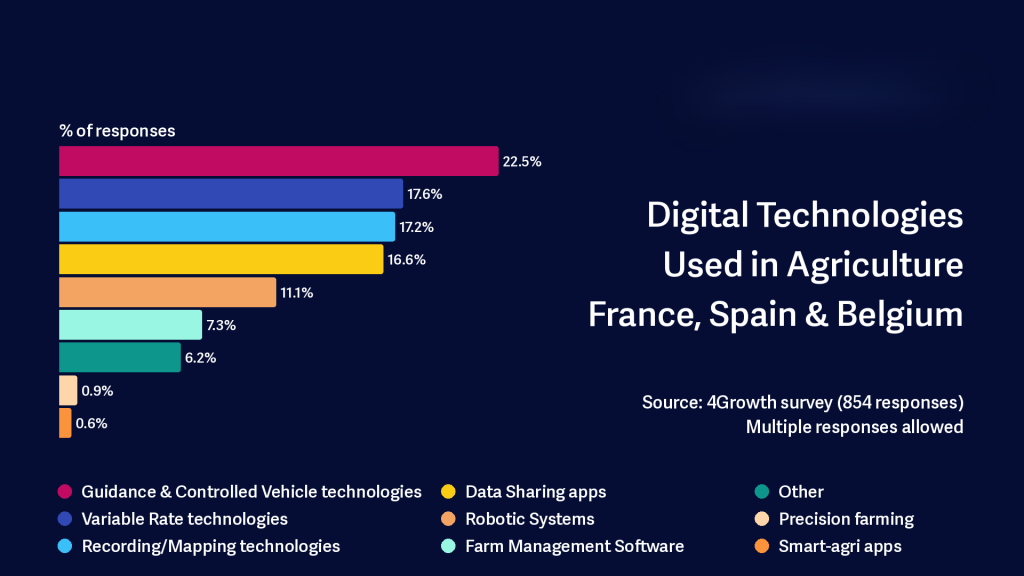
Looking at the technologies respondents already use helps show where digitalisation has progressed furthest. In France, Spain and Belgium, guidance and controlled vehicle technologies are the most frequently reported, at 22.5% of responses. Variable rate technologies (17.6%), recording and mapping technologies (17.2%) and data or information sharing applications (16.6%) follow closely.
In comparison, farm management software (7.3%) and robotics (11.1%) show lower reported uptake. This points to clear differences in how widely respondents have adopted each category of digital technology.
Digital technologies are delivering reported economic benefits, but these benefits vary between the two groups. Most respondents report cost savings or increased efficiency, yet the share ranges from 66% in France, Spain and Belgium to 91% in Poland, Hungary and Lithuania.
The findings also suggest that improved connectivity does not necessarily translate into greater willingness to adopt new technologies. Respondents in France, Spain and Belgium report using guidance, variable rate, recording and mapping, and data sharing technologies more often than robotics or farm management software.
This brings us back to the opening question. In France, Spain and Belgium, connectivity is widespread, yet fewer respondents report economic benefits than in Poland, Hungary and Lithuania. Lower perceived economic benefits may be one of the factors holding back further digitalisation.
Understanding these differences is important for identifying where further support for digitalisation may be most effective.
Explore the data on the 4Growth Visualisation Platform: https://visualisation.4growth-project.eu/survey-analysis
Sign up to stay informed of news, key outputs and upcoming events!