How will digital and data-driven solutions shape the future of agriculture and forestry? This question is critical for farmers, foresters, policymakers, technology providers, investors, and other stakeholders as they develop strategies and initiatives for the decades ahead.
The 4Growth project is exploring the future of digital technologies in agriculture and forestry up to 2040. But the future isn’t linear. It’s shaped by uncertainties, disruptions, and shifting contexts. To navigate this complexity, 4Growth uses two complementary approaches:
The past decade alone has shown us how unpredictable the world can be: Economic and political shifts such as financial crises, Brexit, and the war in Ukraine have reshaped global systems, while global health emergencies like the COVID-19 pandemic and climate-driven extreme weather events have added further layers of disruption.. These disruptions have directly or indirectly impacted agriculture, forestry, and digitalisation.
While historical trends provide a baseline, relying solely on them is risky. A future-proof strategy must account for multiple plausible pathways, not just one. This is why 4Growth is developing alternative scenarios that challenge baseline assumptions and explore how digital technologies might evolve under different conditions.

1. The Baseline
What if current trends continue?
Core assumption
Economic, technological, and regulatory developments evolve steadily, broadly in line with current trajectories.
System characteristics
Implications for agriculture & forestry
Preliminary findings
AI, remote sensing, the Internet of Things (IoT), and automation become increasingly embedded in farm and forest management, supporting decision-making and resource optimisation. Structural challenges remain — including an ageing workforce, regulatory barriers, privacy concerns, and infrastructure limitations — but continued public and private investment sustains innovation.
Our preliminary analysis introduces three alternative scenarios, each posing a distinct “what if” question for 2040:
2. The Corporate Epoch: Multinationals and the New European Order
What if multinational corporations dominate economic growth, technological innovation, and governance?
System characteristics
Implications for agriculture & forestry
Preliminary findings
The installed base of digital forestry technologies exceeds the baseline. However, mergers reduce the number of forestry businesses using these technologies. While prices decline due to scale effects, oligopolistic market structures keep them relatively high.
3. The Fractured Continent: Europe’s Splintered Circular Economy Under Pressure
What if Europe faces increased nationalism, governance fragmentation, and geopolitical tensions?
System characteristics
Implications for agriculture & forestry
Preliminary findings
Digital innovation progresses slowly. Interoperability gaps, limited scaling, and fragmented markets hinder widespread adoption of digital agriculture and forestry solutions.
4. Reimagining Progress: Europe’s New Deal with the Planet
What if Europe leads globally in sustainability, driven by technological innovation and multilateral cooperation?
System characteristics
Implications for agriculture & forestry
Preliminary findings
Digital solutions achieve high uptake across agriculture and forestry. Sustainability-driven demand, strong policy support, and learning effects accelerate technology penetration and innovation.
These scenarios are not predictions, they are explorations of possibilities. They help stakeholders:
The 4Growth project is now moving from scenario development to results generation. The beta model is already delivering first quantitative insights, see the exemplary graph from the 4Growth Visualisation Platform, which will be further refined and expanded as the project progresses. Upcoming outputs will provide a deeper, evidence-based understanding of future digitalisation pathways in agriculture and forestry.
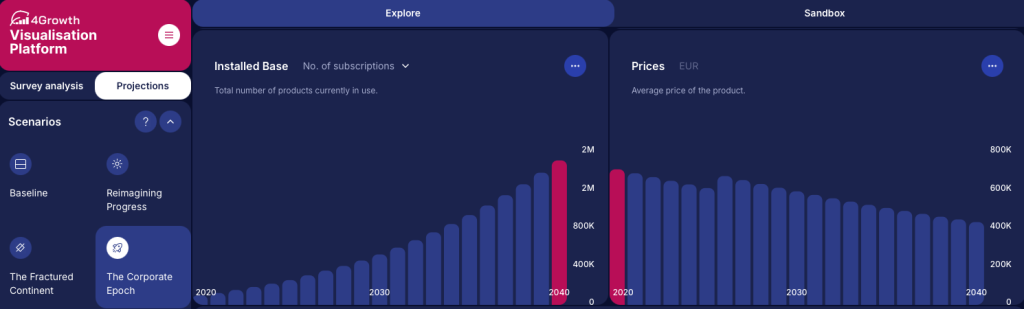
This blog post is the first in a series introducing the 4Growth perspectives on digitalisation futures in agriculture and forestry. We will continue to share insights, data, and analyses as our work progresses.
How do you envision the future of digital agriculture and forestry? Which scenario resonates most with your expectations or concerns?
Sign up to stay informed of news, key outputs and upcoming events!