Within the 4Growth project, ongoing survey work across seven European observatories is generating new evidence on digital technology adoption in agriculture and forestry. With the first two survey waves completed and a third underway, early findings are beginning to reveal how digitalisation is reshaping sectoral practices. This article highlights initial insights from the Finnish forestry Observatory led by VTT — a context characterised by extensive forest resources, strong data infrastructures and a high prevalence of small private forest owners.
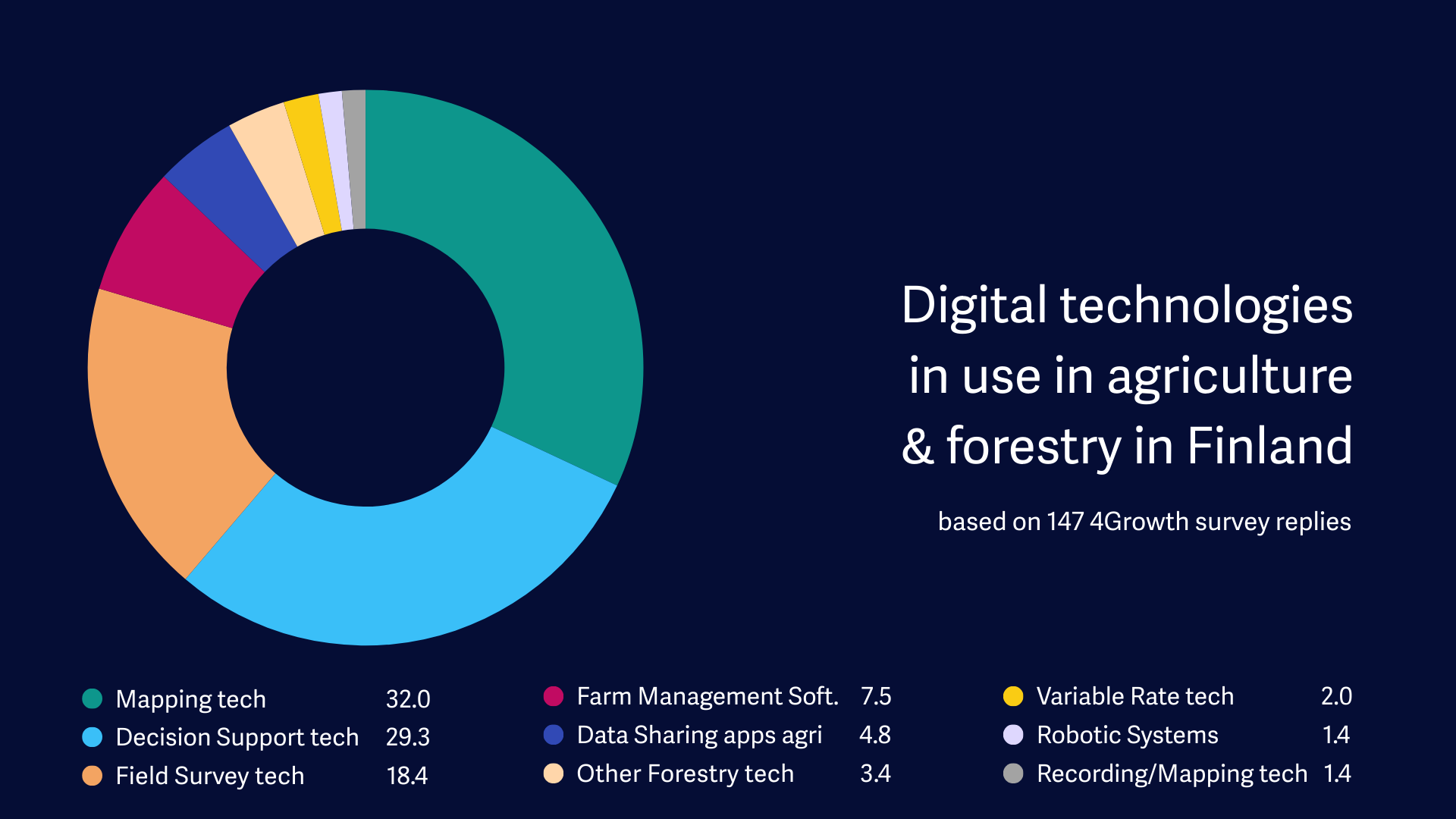
Early results show that digital adoption in Finnish forestry centres on three main technology categories: mapping technologies (32%, 47 out of 147), decision-support tools (29.3%), and field survey technologies (18.4%). Together, these tools enable core forestry activities that rely on spatial analysis, long-term planning and accurate in-field data collection.
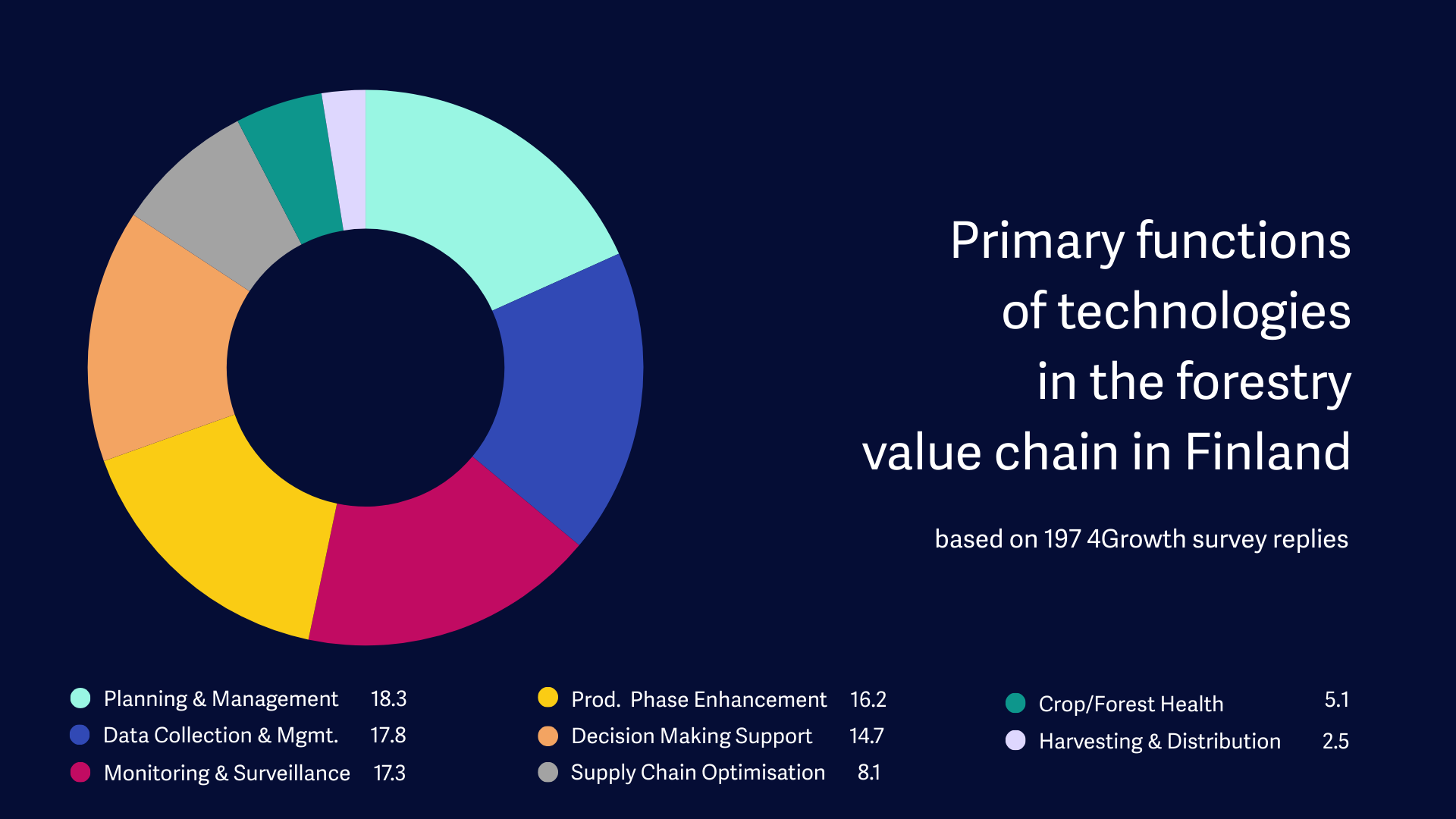
Planning, data management and monitoring emerged as the most frequently reported technological functions. This reflects forestry’s long planning cycles and data-intensive workflows, where operational and strategic decisions depend on reliable and continuously updated information.
Digital literacy and technical knowledge play an important role in the adoption of new technologies. When asked about barriers to further integration of digital technologies, 45% of Finnish respondents (29 0ut of 65) reported no barriers, 23% reported some barriers, and 32% answered “I do not know.” Overall, respondents were generally positive but aware of challenges.
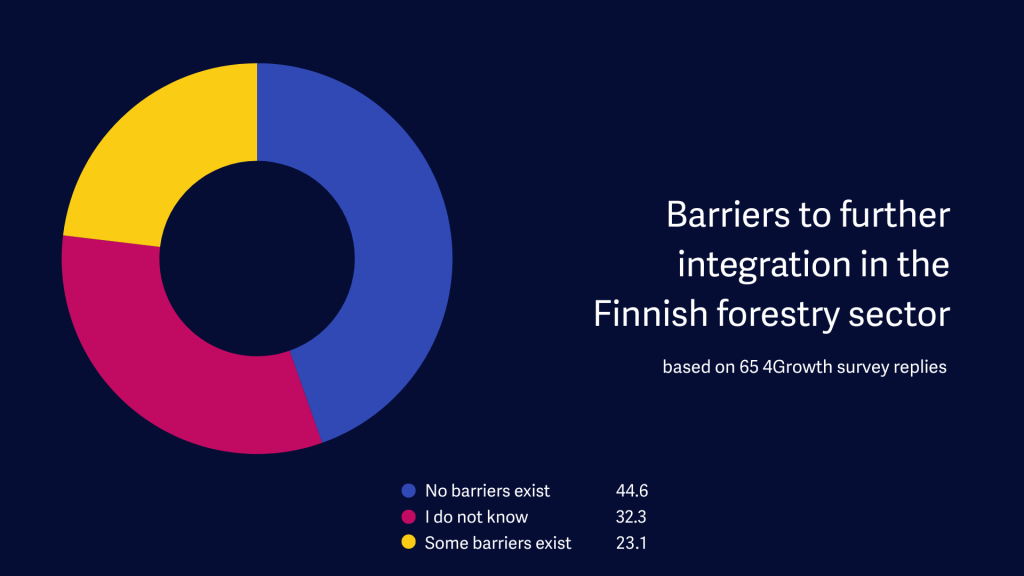
Among the nine respondents who described specific barriers, concerns mainly related to costs, particularly the price of technologies relative to small-scale or infrequent use. They also pointed to fragmented information systems, limited integration between applications, and the need for users to combine data from multiple platforms. Some mentioned gaps in digital competence and insufficient updating of forest data. Given the small number of responses, these barriers should be interpreted as indicative rather than widespread, suggesting practical and organisational challenges rather than systemic resistance to digitalisation.
Most survey respondents represent producers — including forest owners and professional foresters — accounting for 74% of responses. Additional participants include forestry associations (9%), service providers (6%), and processors (5%). Around 90% of respondents represent small organisations, closely mirroring Finland’s ownership landscape, where roughly 60% of forests are privately owned by smallholders.
Fragmented ownership creates strong demand for digital solutions that support efficient planning, service coordination and management across geographically dispersed forest properties.
Survey findings align closely with real-world forestry practices in Finland. The country’s large forest areas, combined with long planning horizons, make digital tools essential for efficient resource management.
Open forest and environmental datasets have played a key role in enabling digital services that support planning, monitoring forest conditions, managing timber sales and coordinating services.
Decision-support tools are widely used in forest management planning, reinforcing the importance of structured data workflows. Mapping technologies — including satellite imagery, drones and LiDAR — are central to forest inventory processes, health monitoring, carbon assessments and disturbance detection across large territories.
Field survey technologies complement remote sensing by allowing foresters to collect and validate data directly on site. Offline-capable mobile applications are particularly valuable in remote environments where connectivity is limited.
Increasingly, these tools are integrated into digital platforms that provide forest owners and forestry professionals with real-time insights for both operational decisions and long-term planning.
Overall, the Finnish forestry sector demonstrates a relatively advanced level of digital uptake. Strong national forest inventory systems and open data policies have supported the emergence of digital platforms that facilitate inventory management, data updates and collaboration across the forestry value chain.
Looking ahead, emerging technologies such as advanced remote sensing and digital twin approaches are expected to further enhance monitoring and decision-making capabilities. Their integration into forestry workflows has the potential to strengthen efficiency, sustainability and resilience across forest management practices.
As the 4Growth surveys continue feeding into the 4Growth Visualisation Platform, future waves will provide deeper insights into how digitalisation evolves across different forestry contexts in Europe, supporting evidence-based policies and innovation strategies for the sector.
Sign up to stay informed of news, key outputs and upcoming events!